Saturday, November 21, 2015

Oral Communication: The Shy & Introverted

Susan Cain presents a TEDTalk on The Power of Introverts. In this talk she addresses the ways which our culture values being social and outgoing especially in our education systems and work. Cain discusses how it may feel shameful or difficult under these conditions to be an introvert and highlights all the wonderful abilities introverts have to offer, and why introversion should be encouraged and celebrated. 


Cain, Susan. The power of introverts. 2012. URL: https://youtu.be/c0KYU2j0TM4


During my observation days at my placement I have noticed how fearful most of the students can be when it comes to public speaking. Their public speaking unit does not begin until next term, yet throughout the whole fall they refer to when they will have to do speeches and how nervous they are for them. It is interesting to me that they have been dwelling on a 3 minute speech that they will be presenting months away. This is mostly because of the idea that at some point in their year as eighth graders they know that everyone in the class will be looking at them as they stand in front of the room and present something that they have come up with themselves.

Last week I was able to see a sneak preview of how they will be when it comes to the public speaking unit that I will be preparing and executing in my teaching block. They were asked to take a short article from a Remembrance Day newspaper, read it to themselves, and come up with the main points and a 1 minute synthesis to tell the class what the article was about. Fear struck. It is safe to say the entire class bombed this activity. Even those students who were nailing the comprehension of the article were flopping in their oral communication because of the sheer terror of speaking in front of their peers. 

This is the greatest challenge that they will have to overcome when public speaking, and they may not overcome it. And the greatest challenge for me, as their teacher, will be preparing lessons in order to strengthen the confidence of the students and to relieve some of the stress the burden of oral communication puts on them. This can be done through activities and TEDTalks that support metacognition and reflecting on oral communication skills and strategies. We will identify what strategies they found most helpful before, during, and after listening and speaking and what steps they can take to improve their oral communication skills. (Ontario Language Curriculum, p. 140)

Photo courtesy of ©iStockphoto.com/uschools

One of the ways I would like to promote metacognition of oral communication skills is through TEDTalks. TEDTalks that are based on topics such as public speaking, body language, fear, and introversion. This brings me back to the TEDTalk above by Susan Cain. Many of the students in my class may label themselves introverted or shy, which is why they feel so fearful when it comes to presenting their ideas to a class. Cain makes the distinction that, being shy is the fear of social judgment and introversion (and extroversion) is the way that we respond to social stimulation. In the most cases introversion and being shy go hand in hand. Cain labels herself as an introvert and towards the end makes the comment that even though she is honoured to speak to the audience in this platform, this is also not where she is most comfortable. She is a model of how even though the students may believe that they are under one label and comfortable in one area, oral communication is still a safe platform for the shy soft spoken person to relay their ideas. 

During her talk she states that some of our most transformative leaders were introverts such as Eleanor Rosevelt, Rosa Parks, Ghandi; all these people described themselves as quiet, soft spoken and even shy. They all took the spot light even though every bone in their bodies was telling them not to.I think this point may be one of the most important for students to know; that leaders such as these took the spotlight and directed not because they were comfortable or outgoing, but because their ideas led them to do so. I also believe that it is important for students to have the mindset that if you are shy and introverted you will not fail at public speaking. Yes, extroverts may thrive and feel comfortable communicating their ideas orally but introverts, who may not thrive in the same environment, still have the power to convey ideas effectively. In the examples Cain gives of these global leaders, and also in the example of her grandfather the Rabbi, students are able to see that that public speaking and outgoing-ness are not one in the same. 

TEDTalks, such as this one by Cain, can inspire self confidence and motivate students to practice public speaking, or as Cain calls it, "speaking dangerously". 

References:
Ministry of Education. The Ontario Curriculum Grades 1 -8: Language. 2006. Accessed: November 21, 2015. URL: http://www.edu.gov.on.ca/eng/curriculum/elementary/language18currb.pdf


Susan Cain. The Power of Introverts. 2012. URL: 
https://youtu.be/c0KYU2j0TM4


Thursday, November 12, 2015

Writing with an Audience in Mind

Writing provides students with the opportunity to learn about themselves and their connection to the world. When students are given numerous opportunities to write they are building the skills to organize their ideas and be effective communicators, the writing process allows them to clarify their thinking and express their thoughts and feelings. Through various writing assignments students are expected to create products of interesting, original, and independent critical thought, but what happens when we do not provide students with opportunities of various ways they can present their ideas?

According to the article Gradually Releasing Responsibility to Students Writing Persuasive Texts, there are three kinds of texts that students need to learn to write; argument, exposition, and narrative. The article also says, "Given that many teachers neglect the teaching of writing altogether, or focus more on narrative texts, this emphasis on the Common Core on writing means that students need more experience with writing argument or exposition." (p.4) As important as I believe creative writing to be and that students should be creating narratives, developing characters and crossing boundaries of what standard academic writing provides to them. I do also believe that there should be much more emphasis on argument and exposition; with these two types of texts students are better able to delve into the ideas that they feel passionate about and organize supportive information to be presented to an audience.

And this is where I would like to pose my question....


How do we teach students how to effectively communicate their ideas to an audience?

Yes, we know from the above article that we are able to use the IMSCI model for scaffolding writing instruction (more information on IMSCI model here). But what exactly are we modelling? What do we want our students to know about how to effectively prepare and communicate ideas through argument and exposition and how to present their products to an audience?

Nancy Duarte. Uncovering the Common Structure of Greatest Communicators. TEDxEast. November 11, 2010. URL: https://www.youtube.com/watch?v=1nYFpuc2Umk

Nancy Duarte, in the TEDxEast talk above, explains the model that she has developed for creating transformative presentations through analyzing speeches by Martin Luther King and Steve Jobs. 

Duarte in her talk states, "You have the power to change the world... Deep inside of you, every single one of you has the most powerful device known to man. And that's an idea." She continues to explain the process of how she came up with her model of transformative presentations but first she makes a riveting point by using hero archetypes in comparison. That is that we are not the heroes of our ideas, the audience are the heroes of our ideas, because we can have an idea but it needs to spread in order for it to be effective. She goes on to explain the role of the hero archetype; there is a likeable hero in an ordinary world and they get this call to adventure, which then their world is brought out of balance. At first they are resistant, and then a mentor comes along and helps them move from their ordinary world into a special world. And that is the role of the presenter, to be the mentor, so as writers we are presenting our idea to an audience and helping them move from one thing into our new, special idea, and that is the power of the story. 

Background Image: WarriorProse.com. November 24, 2010. URL: http://bit.ly/1lmtN55

Duarte explains the shape-structure of stories, and asks if a presentation had a shape what would it look like? And how do the greatest communicators use that shape if there is even a shape? Using Martin Luther King's I Have a Dream speech and Steve Jobs' 2007 iPhone Launch speech and overlaid the two on this structure and found that both fit. Duarte found that these speeches both started with establishing "What is" (the status quo, the commonplace), which needs to be compared with "What could be" (imagine a different future because of this special idea). And that gap between the two needs to be made as big as possible and highly contrasted. This shape goes back and forth, up and down between the what is and what could be until there is a call to action, a new bliss, which is presented in a poetic and dramatic way. 

Shape of story based on Duarte's structure of an effective presentation
(Chamberlain, 2015)
Duarte also uses this model to analyze the transcripts of both Martin Luther King's and Steve Jobs' speeches in depth to find what what types of techniques they have used in their speeches that had made them so effective. She finds that the presenters model for their audience what they want them to feel (ex. Isn't this wonderful?) and compelling them to feel a certain way. They turn to a personal story to keep the audience involved or anecdotes, they use a lot of metaphors people are familiar with and visual scenes with their words to take complicated ideas and make them memorable. And in the new bliss they use familiar quotes, or songs, or pieces from scripture that reach inside the hearts of the audience and what is important to them as a device to connect and resonate with the audience to paint this picture of a new bliss. 

_________________________________________________________________________

When we are thinking about teaching argument and exposition to our students we should not only be modelling how to properly write, but how to properly write with an audience in mind. Using some of the techniques in Duarte's model of what makes an effective presentation, we can properly teach students what they should be keeping in mind when conveying their idea to an audience and what is going to make that idea connect and resonate with them. Writing argument and exposition can be looked at as a presentation, students are presenting their ideas to the world and this basis Duarte has conveyed will help students to effectively communicate their ideas.


References:
Ministry of Education. The Ontario Curriculum Grades 1 -8: Language. 2006. Accessed: November 12, 2015. URL: http://www.edu.gov.on.ca/eng/curriculum/elementary/language18currb.pdf


Nancy Duarte. Uncovering the Common Structure of Greatest Communicators. TEDxEast. November 11, 2010. URL: https://www.youtube.com/watch?v=1nYFpuc2Umk

Read, S., Landon-Hays, M. & Martin-Rivas, A. (2014). Gradually releasing responsibility to students writing persuasive text. The Reading Teacher, 67(6), 469-477. URL: http://onlinelibrary.wiley.com.proxy.library.brocku.ca/doi/10.1002/trtr.1239/abstract


Tuesday, October 27, 2015

The Arts for Reading Comprehension


This past weekend I attended the conference Arts Matters: Integrating Arts Across the Curriculum hosted by Brock University. The focus of this conference was on valuing the arts and their integration across the curriculum. I found the conference to be extremely valuable in that we were able to see how the four arts disciplines could be carried through cross curricular teaching, and how consolidation with the arts will help students become highly reflective, holistic thinkers.

What I found most interesting about the workshops was that each discipline was related back into language arts in some way.  For example, in drama we were read to or given texts and with our groups we were to regurgitate our understanding and present with action what we understand of that story. In dance we had a similar experience, but instead we put related our understanding to actions which came out in body movements with music. It is this interweaving of the curriculum that has been highlighted and how we can generate comprehensive responses to stories by consolidating with the arts.

What our key note speaker, David Booth, discussed prior to our activities, was the idea of "How One Story Can Generate A Thousand Responses through the Arts." He discussed a study he did with thousands of teachers in different countries with versions of the book The Selkie. His presentation was based on the variety of ways teachers generated a thousand different responses with the same story, using the arts. What I found most riveting about his presentation was that through creative expression, students were able to attend to their deeper levels of connection of text to self. The arts are creative mediums for comprehension; they are forms of communication, an extension of the person who has created it, a way of expressing internal feelings or thoughts, and a way of demonstrating understanding.


Letters between lovers, imagined by first grade student, Phoebe.
Image: Chamberlain, Julia (c)


In developing the knowledge and skills to have students become effective readers. The Ontario curriculum says that, "An effective reader is one who not only grasps the ideas communicated in a text but is able to apply them in new contexts. To do this, the reader must be able to think clearly, creatively, and critically about the ideas and information encountered in texts in order to understand, analyse, and absorb them and to recognize their relevance in other contexts."

When we think about reading and comprehension strategies, within this realm of being an effective communicator by relating text to new contexts, integrating the arts allows for another outlet for comprehension. When the reader is able to consolidate their understanding through illustration, song or body movement they are automatically applying their comprehension to new contexts that is reflective of what they know. The article, "Using Art to Teach Vocabulary and Reading Comprehension" by the University of Illinois at Chicago (UIC), discusses how the arts is used as a form of expression for students with learning disabilities that have a difficult time expressing thoughts through speech and words and when we integrate the arts, these students can begin to illustrate their ideas through movement or spatial understanding, or textures. Ellen Holtzblatt, who is a student, teacher, and art therapist says, "I start with text and then use a combination of the other modalities to deepen the students' experience. Art bypasses verbal limitations and intellectual expectations." The arts allow for a freedom of expression that some students may not be able to convey otherwise, being limited with their verbal abilities. A lesson with arts consolidation would opt for an improved Universal Design for Learning.


Education Possible. 5 easy ways to Ignite Kids' Creativity. Nov 6 2013. Accessed: October 27, 2015. URL: http://educationpossible.com/5-easy-ways-ignite-kids-creativity/


So how does a seven year old know about such love? How was Phoebe able to read The Selkie and comprehend her understanding of the text by imagining a love so vast that the two characters simply just could not bare to live without each other? There is something the arts activates between prior knowledge where students can question, visualize, synthesize and preform what they know to be true. In Phoebe's case, this act of role playing allowed her to imagine these star-crossed lovers, which she expressed on an extremely deep level. The arts have this wonderful ability to allow us as creators to dig deep within ourselves and to express what we find, and use that expression to tell stories. So it is true what Dr. Booth says about one text generating a thousand responses, and the arts is a way to take stories and generate what we understand to be their meaning.


References: 

Ferguson, Kristen. Performing Poetry: Using Drama to Increase the Comprehension of Poetry. Ontario Ministry of Education Research Monograph #52. March 2014. Accessed: October 27, 2015. URL: https://www.edu.gov.on.ca/eng/literacynumeracy/inspire/research/WW_PerformPoetry.pdf

Ministry of Education. The Ontario Curriculum Grades 1 -8: Language. 2006. Accessed: October 7, 2015. URL: http://www.edu.gov.on.ca/eng/curriculum/elementary/language18currb.pdf

STEP=UP (Special Teachers and Exceptional Pupils = Urban Promise). Using Art to Teach Vocabulary and Reading Comprehension. University of Illinois at Chicago. Vol 4 Issue 4. September 1, 2007. Accessed: October 27, 2015 URL: https://www.uic.edu/orgs/stepup/documents/NewsletterSeptember2007.pdf


Used Books in Class. Teacher's College 87tth Reunion: David Booth and a Thousand Stores. October 22, 2014. Accessed: October 27, 2015. URL: http://usedbooksinclass.com/2014/10/22/teachers-college-87th-reunion-david-booth-and-a-thousand-stories/


Wednesday, October 7, 2015

Media Literacy

What is Media Literacy?

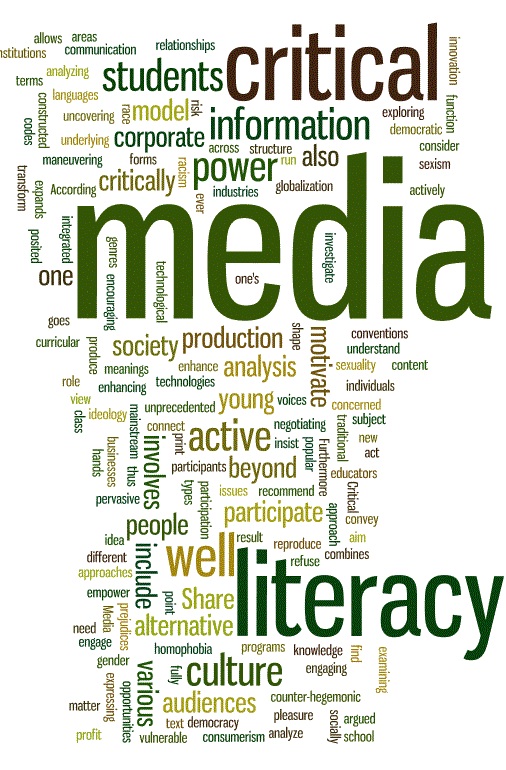
First, we should establish what it exactly means to be media literate. The Ontario Curriculum for Language defines media literacy as, "the result of study of the art and messaging of various forms of media texts." Traditional literacy may focus on the understanding of a word, where as media literacy focuses on the construction of meaning through combining several media languages (graphics, sounds, images, and words).

Media Texts:
  • Can be understood to include any work, object, or event that communicates meaning to an audience 
  • Uses words, graphics, sounds, and/or images, in print, oral, visual, or electronic form, to communicate information and ideas to their audience.

Ontario Curriculum Four Media Strands

1. Demonstrate an understanding of a variety of media texts;
2.  Identify some media forms and explain how the conventions and techniques associated with them are used to create meaning;
3. Create a variety of media texts for different purposes and audiences, using appropriate forms, conventions, and techniques;
4. Reflect on and identify their strengths, areas for improvement, and the strategies they found most helpful in understanding and creating media texts. 

Ross, E.Wayne. EDCP333/2012 Groups/Critical Media Literacy. The University of British Columbia. 2012. Accessed: October 7, 2015. URL: http://wiki.ubc.ca/images/d/db/Mediapic.jpg

But....


Why is it important for us to learn?

The 21st century is an age of digital learners, but in addition to this we are also in the age of the image. Television, video games, photographs, magazines, the computer, all of these resources of media contribute to this new language of communication, images. It is on day to day basis that we are bombarded with media and at the same time there is a decline in actual text or content and the formal literacy behind what we are seeing, in this case we claim the idea that, "the medium is the message." This is a new 21st century language, in which we must prepare our students to communicate in and evaluate these messages.

In addition to the 3 R's; reading, writing, and arithmetic, we must also remember the arts; visual, music, and dance.  The fluency of these are necessary for the understanding of this new language. Digital information comes in multiple forms such as graphics, sounds, images, in addition to words, if we can comprehend the arts we can have a broader understanding that stories can be told in multiple ways that are not just linear with words. If we can understand this, then we can use our visual-interpretive skills to interact with media analytically.

In this new age of images we must become media literate in order to effectively and intelligently interpret visual actions, objects, symbols, and competently assess new visual information. And while doing this we can learn how to effectively research information, assess it's quality, and how to use media in order to communicate in creative and persuasive ways. 

We are preparing our learners for the digital age where it is necessary to be fluent in media literacy. While we do not want to hinder formal literacy at all, we want to combine it with this new language so that students may grow to understand multiple ways of expression of story-telling and be aware of the persuasions and capabilities of visual and media culture.


Quijada, Andrea. Creating critical thinkers through media literacy. TEDxABQED. February 29, 2013. Accessed October 7, 2013. URL: https://youtu.be/aHAApvHZ6XE


Andrea Quijada in this TEDx Talk acknowledges ways in which interpreting and evaluating media can help create critical thinking. She discusses text (what we see and are told) and sub-text (what we are not told) and why it is important to teach students to deconstruct media; so that they can connect school to their 21st century real, daily lives. 


References:
Ministry of Education. The Ontario Curriculum Grades 1 -8: Language. 2006. Accessed: October 7, 2015. URL: http://www.edu.gov.on.ca/eng/curriculum/elementary/language18currb.pdf
Shlain, Leonard. Media Literacy is Vital in the Age of the Image. Edutopia [September 26, 2005]. Accessed October, 7, 2015. URL: http://www.edutopia.org/visually-speaking