First, we should establish what it exactly means to be media literate. The Ontario Curriculum for Language defines media literacy as, "the result of study of the art and messaging of various forms of media texts." Traditional literacy may focus on the understanding of a word, where as media literacy focuses on the construction of meaning through combining several media languages (graphics, sounds, images, and words).
Media Texts:
- Can be understood to include any work, object, or event that communicates meaning to an audience
- Uses words, graphics, sounds, and/or images, in print, oral, visual, or electronic form, to communicate information and ideas to their audience.
Ontario Curriculum Four Media Strands
1. Demonstrate an understanding of a variety of media texts;
2. Identify some media forms and explain how the conventions and techniques associated
with them are used to create meaning;
3. Create a variety of media texts for different purposes and audiences, using appropriate
forms, conventions, and techniques;
4. Reflect on and identify their strengths, areas for improvement, and the strategies they
found most helpful in understanding and creating media texts.
 |
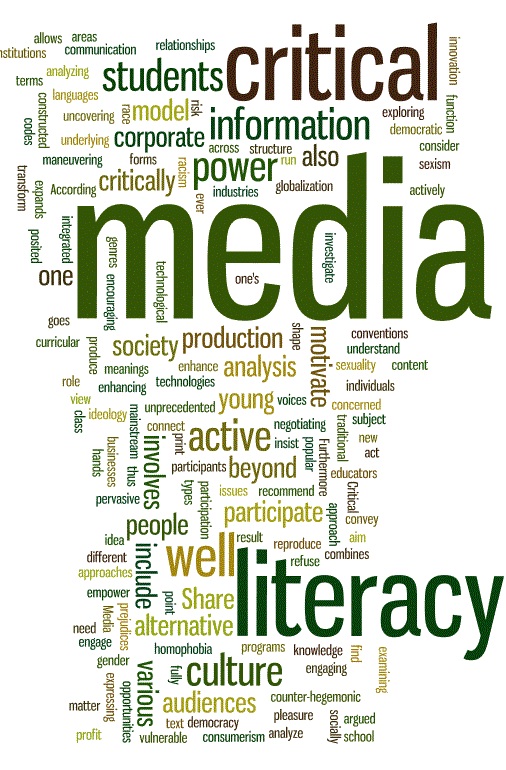
| Ross, E.Wayne. EDCP333/2012 Groups/Critical Media Literacy. The University of British Columbia. 2012. Accessed: October 7, 2015. URL: http://wiki.ubc.ca/images/d/db/Mediapic.jpg |
But....
Why is it important for us to learn?
The 21st century is an age of digital learners, but in addition to this we are also in the age of the image. Television, video games, photographs, magazines, the computer, all of these resources of media contribute to this new language of communication, images. It is on day to day basis that we are bombarded with media and at the same time there is a decline in actual text or content and the formal literacy behind what we are seeing, in this case we claim the idea that, "the medium is the message." This is a new 21st century language, in which we must prepare our students to communicate in and evaluate these messages.
In addition to the 3 R's; reading, writing, and arithmetic, we must also remember the arts; visual, music, and dance. The fluency of these are necessary for the understanding of this new language. Digital information comes in multiple forms such as graphics, sounds, images, in addition to words, if we can comprehend the arts we can have a broader understanding that stories can be told in multiple ways that are not just linear with words. If we can understand this, then we can use our visual-interpretive skills to interact with media analytically.
In this new age of images we must become media literate in order to effectively and intelligently interpret visual actions, objects, symbols, and competently assess new visual information. And while doing this we can learn how to effectively research information, assess it's quality, and how to use media in order to communicate in creative and persuasive ways.
We are preparing our learners for the digital age where it is necessary to be fluent in media literacy. While we do not want to hinder formal literacy at all, we want to combine it with this new language so that students may grow to understand multiple ways of expression of story-telling and be aware of the persuasions and capabilities of visual and media culture.
Andrea Quijada in this TEDx Talk acknowledges ways in which interpreting and evaluating media can help create critical thinking. She discusses text (what we see and are told) and sub-text (what we are not told) and why it is important to teach students to deconstruct media; so that they can connect school to their 21st century real, daily lives.
References:
Ministry of Education. The Ontario Curriculum Grades 1 -8: Language. 2006. Accessed: October 7, 2015. URL: http://www.edu.gov.on.ca/eng/curriculum/elementary/language18currb.pdf
Shlain, Leonard. Media Literacy is Vital in the Age of the Image. Edutopia [September 26, 2005]. Accessed October, 7, 2015. URL: http://www.edutopia.org/visually-speaking
The 21st century is an age of digital learners, but in addition to this we are also in the age of the image. Television, video games, photographs, magazines, the computer, all of these resources of media contribute to this new language of communication, images. It is on day to day basis that we are bombarded with media and at the same time there is a decline in actual text or content and the formal literacy behind what we are seeing, in this case we claim the idea that, "the medium is the message." This is a new 21st century language, in which we must prepare our students to communicate in and evaluate these messages.
In addition to the 3 R's; reading, writing, and arithmetic, we must also remember the arts; visual, music, and dance. The fluency of these are necessary for the understanding of this new language. Digital information comes in multiple forms such as graphics, sounds, images, in addition to words, if we can comprehend the arts we can have a broader understanding that stories can be told in multiple ways that are not just linear with words. If we can understand this, then we can use our visual-interpretive skills to interact with media analytically.
In this new age of images we must become media literate in order to effectively and intelligently interpret visual actions, objects, symbols, and competently assess new visual information. And while doing this we can learn how to effectively research information, assess it's quality, and how to use media in order to communicate in creative and persuasive ways.
We are preparing our learners for the digital age where it is necessary to be fluent in media literacy. While we do not want to hinder formal literacy at all, we want to combine it with this new language so that students may grow to understand multiple ways of expression of story-telling and be aware of the persuasions and capabilities of visual and media culture.
Quijada, Andrea. Creating critical thinkers through media literacy. TEDxABQED. February 29, 2013. Accessed October 7, 2013. URL: https://youtu.be/aHAApvHZ6XE
References:
Ministry of Education. The Ontario Curriculum Grades 1 -8: Language. 2006. Accessed: October 7, 2015. URL: http://www.edu.gov.on.ca/eng/curriculum/elementary/language18currb.pdf
Shlain, Leonard. Media Literacy is Vital in the Age of the Image. Edutopia [September 26, 2005]. Accessed October, 7, 2015. URL: http://www.edutopia.org/visually-speaking

No comments:
Post a Comment